
Guaranteed to spice up ones armoury, the front loop is the base move for so many kiting tricks, that it be often regarded with awe and fear. Perhaps because it looks so smooth, and some how un-dangly, it seems to scare prospective freshers away, who then seem intent on focusing all their efforts on the back loop.
Well fear ye not. We actually teach our students the front loop before the omnipresent back loop. To understand why, you must firstly appreciate what exactly a front loop is. Any grandiose notions of a perfectly executed front somersault whilst flying 10 meters above the oceans surface should be put aside.

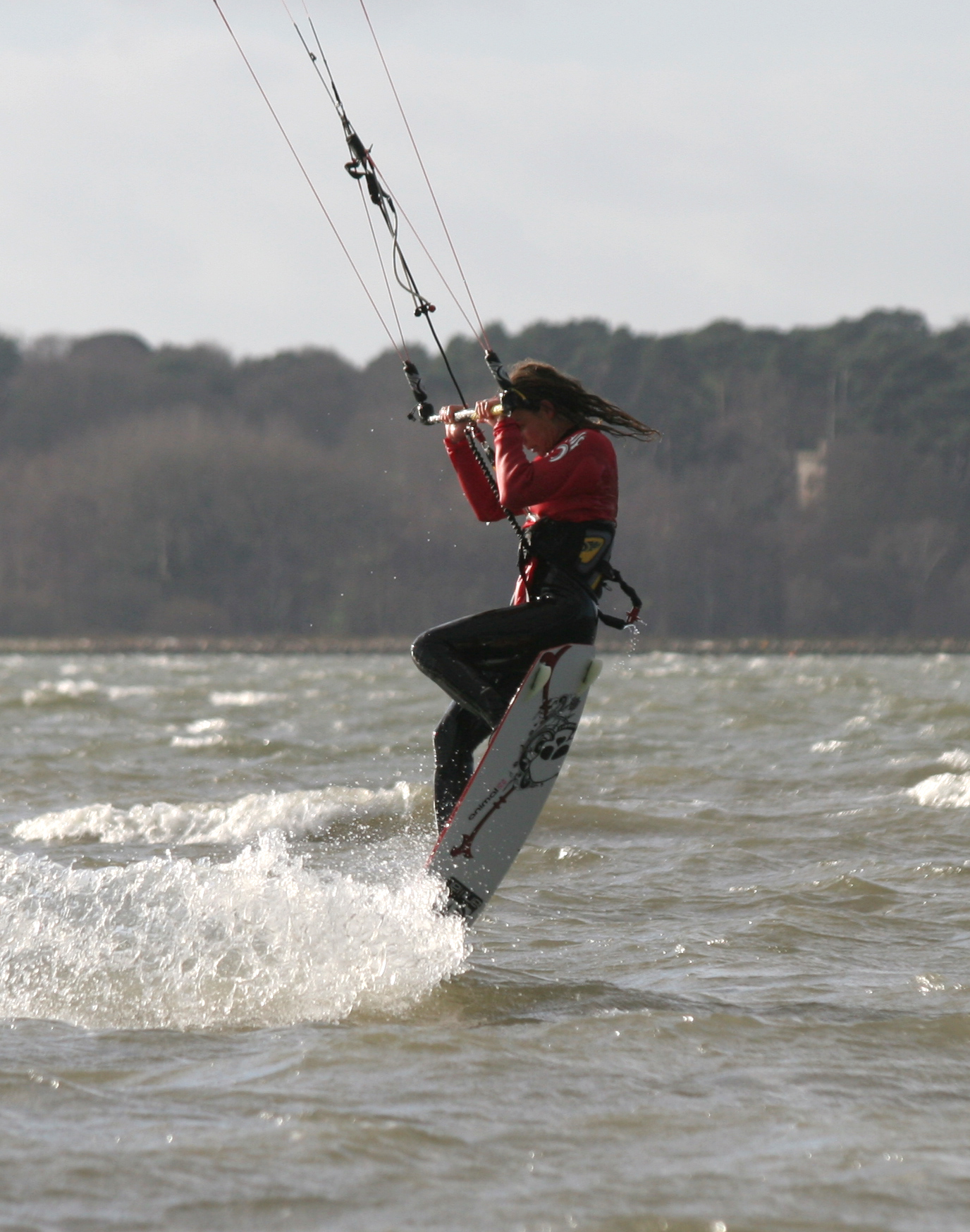
In fact all of us have probably been pulling off kite-esque front loops since being knee high to a grasshopper. Hanging off swings, or flaying around on ropes over canals, you can probably remember almost getting dizzy with the amount of spins you achieved. The rotation we are after is exactly that of our childhood summers – spinning around a mostly vertical axis. In this case the rope is merely replaced by our flying lines, and rope burn is replaced by chaffing.
The only pre-requisite for learning to front roll is a controlled jump, as the approach, kite control and landing are all pretty much the same. The main difference being that as you rotate there will be little opportunity for a cheeky peak to find out where the kite is, so having a feeling of where you and the kite are will be of benefit.
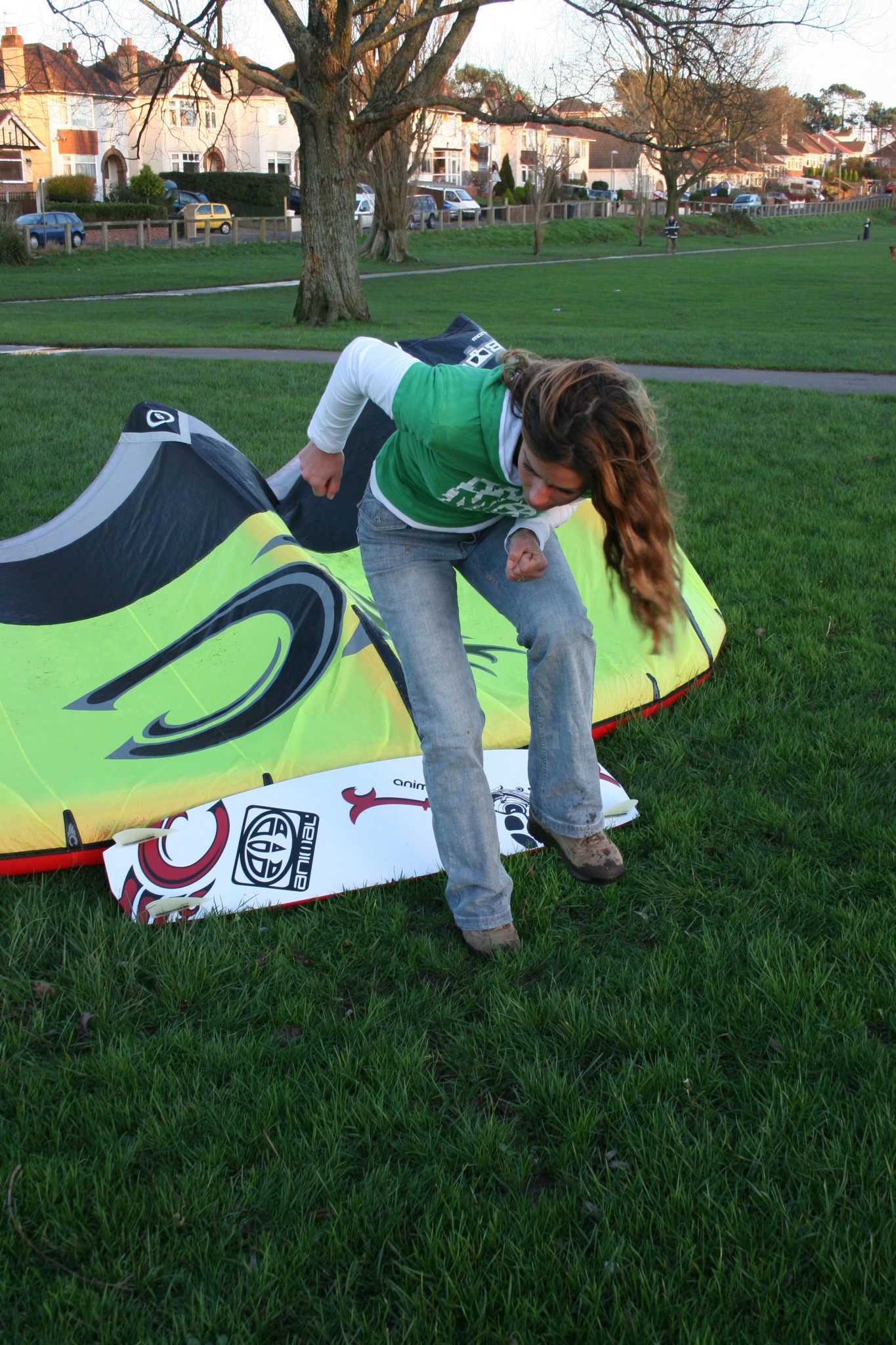
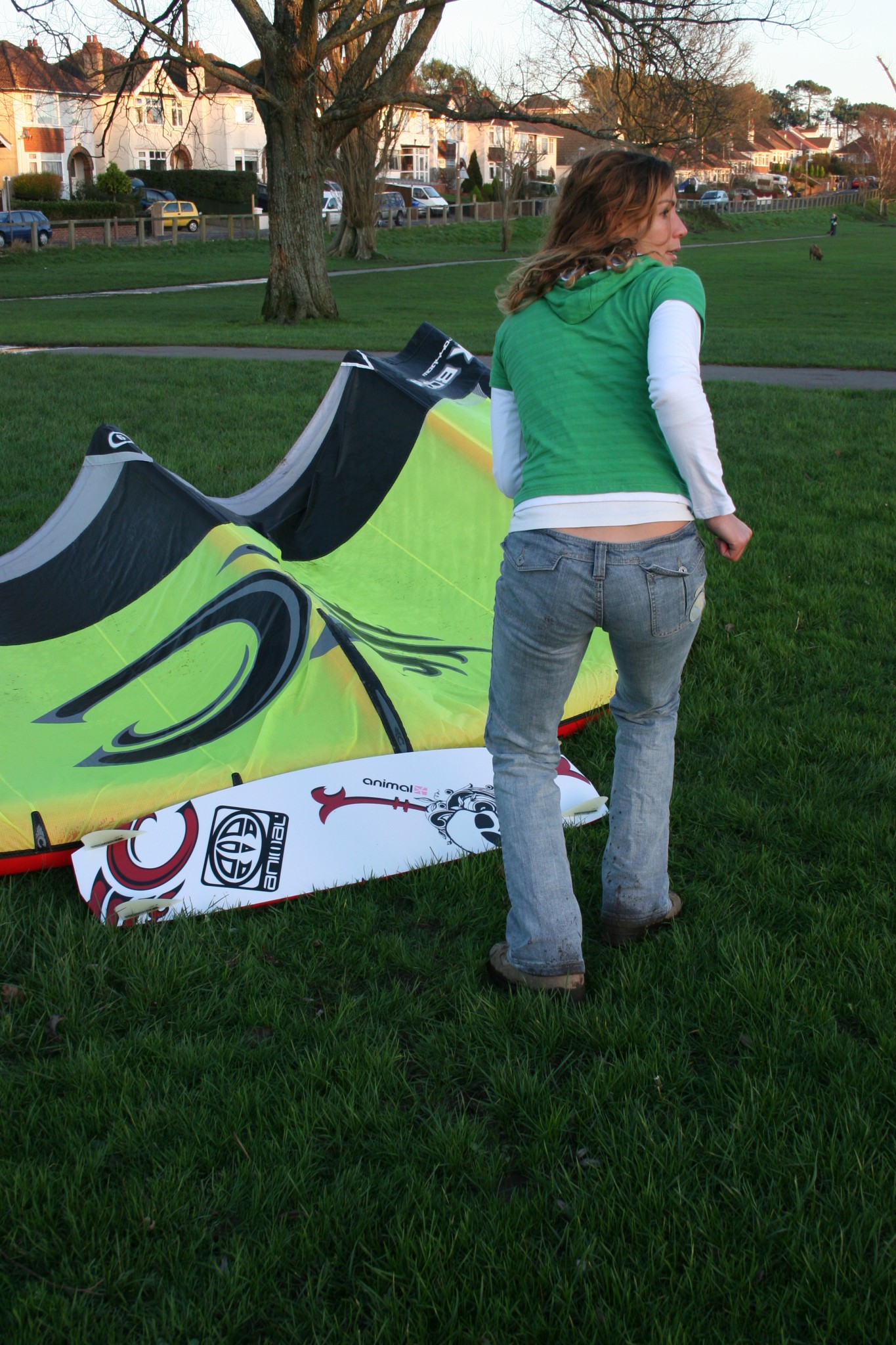
As always it’s a good idea to get the key body movements sorted on terra firma. Here we are looking from downwind and Karine is, if somewhat mythically, riding to her left.
In Pic A. Karine has thrown her head and shoulders down towards the nose of the board and is looking slightly behind. In fact she is convinced that I’m sitting there and is actually trying to give me a kiss. To make this easier she has bent her knee and lifted her front foot. You could also perhaps imagine that someone has taken a hefty swing at your crown jewels. This initiates the rotation and should guarantee at least 180. Lifting the front foot also helps keep the board on your feet as it prevents the nose of the board sticking to the water.
In Pic B. Karine has flicked her head around over her trailing shoulder and would be searching for water downwind of her. By trying to spot her landing Karine will continue to rotate. And she has not allowed herself time to stop and stare upwind. Great for stalling a rotation, but not recommended when learning.
The ability to get off the water combined with these two movements will see you through your first front loop.
To get honed for the front loop we are going to break it down.
As with a normal jump, our approach should afford us enough speed, power and space to confidently commit to the ensuing airtime.
Although speed is our friend, control is paramount. If you go blatting into a jump, barely on an edge, holding on for dear life, you’ll more than likely fly off down wind a few inches above the water. Not ideal spawning conditions for any new move.
Inversely, if you approach edging as hard upwind as humanly possible, you will have taken off so much speed that without sending the kite several miles behind you, there is little chance of gaining enough height for a completed loop.

Although it is unadvisable to go for your biggest jump ever, you should not tip toe into the front loop. By the very nature of the take off you will loose your edge a fraction too early, and will therefore not necessarily reach the altitude to which you are accustomed.
Our take off will initiate the loop, so it’s the crux. Just as you feel the kite start to lift you, is the time to throw head and shoulders down and lift the front foot. Too early and the board will stick, you’ll come flying out of the straps or worse still nothing will happen at all. Too late and you’ll find yourself looking backwards, with very little or no rotation. This is also a very good time to remember which is your front hand, as you will need to start re-directing the kite.
Once you are on the way up and spinning you need to get yourself small, redirect the kite and get your head around. As you bring you’re knees up, try bringing your hands down to your hips. This will keep the kite powered and responsive, and so long as you did not send the kite too far back behind you on take off, it should not require too much from the front hand to get it back up above you. Flick your head round to keep the rotation going and spot your landing. You will spin more easily now that you are small.
On decent you should aim to finish your rotation by landing with the board pointing downwind. You can assist this idea becoming a reality by diving the kite as you approach the surface, so that the power in the kite pulls you out of the rotation and results in a smooth landing. Don’t lower your undercarriage too early as this could pull you off balance just milliseconds before landing your first one…
Walk through the rotation doing Waltz like pirouettes on land until you have firmly embedded in the grey matter.

Unless you are a moto-cross loony named Ian (from the valleys), you do not need huge height to get around. This may result in a tumble or two, which could dampen your enthusiasm.
Your initial aim should be to complete a front loop, even landing on your backside with the kite still flying above you. From here it is easy to build on your gained confidence to pull a bit harder, a tad sooner on the front hand to chive that coveted planning exit.
A common problem is finding the kite behind you when you land. To solve this try edging more during take off and keep your derriere lower.
Don’t forget the kite! It is easy to freeze on the back hand but you need to pull the kite forward from take off onwards. The lowering of the front shoulder is a good opportunity to push on the front hand.
If you are over-rotating try dropping the back hand. This looks pretty groovy, leads to a whole host of cheeky grabs but is also darn effective at opening the body up and slowing the rotation down.

In all honesty there is no great science to the front loop. Trying it may well be the hardest part. If you can overcome the initial fear the rest should fall into place nicely. Have fun trying!
This technique article was in Issue 2 of IKSURFMAG.
By Christian and Karine
Christian and Karine have been working together as a coaching team, running improver to advanced kitesurfing clinics since 2003.