

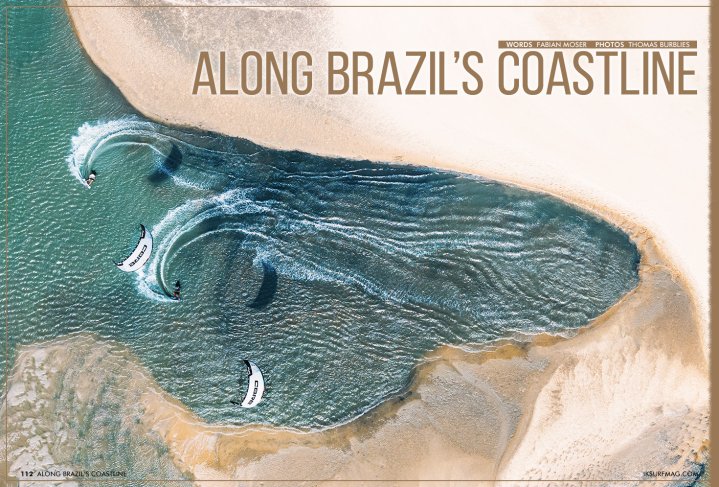
Along Brazil’s Coastline
Issue 112 / Tue 19th Aug, 2025
When Fabian Moser landed in Brazil for the first time, he expected good kiting, but what he got was a full-on adventure! This trip with the CORE team was about more than gear testing. It was a deep dive into the rhythm, colour, and untamed beauty of Brazil’s coastline.
Your first time visiting a new country is always a special experience. Last December, I had the opportunity to experience Brazil for the first time, and not just Brazil, but South America as a whole. I landed late at night in Fortaleza, and during the hour-long car ride south to Barra Nova, I could barely make out anything beyond the headlights. So when I woke up, jet-lagged, at 4:30 am the next morning and stepped out of my room, the impact was even stronger. Coming from European winter, I suddenly found myself in a town filled with cashew trees, a warm breeze drifting through, and a friendly pack of dogs strolling the sandy streets to greet me. It was the perfect start to what would become an epic kite adventure.
I joined the CORE team to help document the launch of the new Fusion 7 board and Pace kite, and to explore the coast of Ceará while putting the gear through its paces. While I was still adjusting to the heat and rhythm of life, Thomas Burblies and Julieta Pereyra were already organising all the camera and kite gear for the days ahead. Once Willow River Tonkin and Michelle Roberts arrived, the team was complete, and we began scouting nearby kite spots.
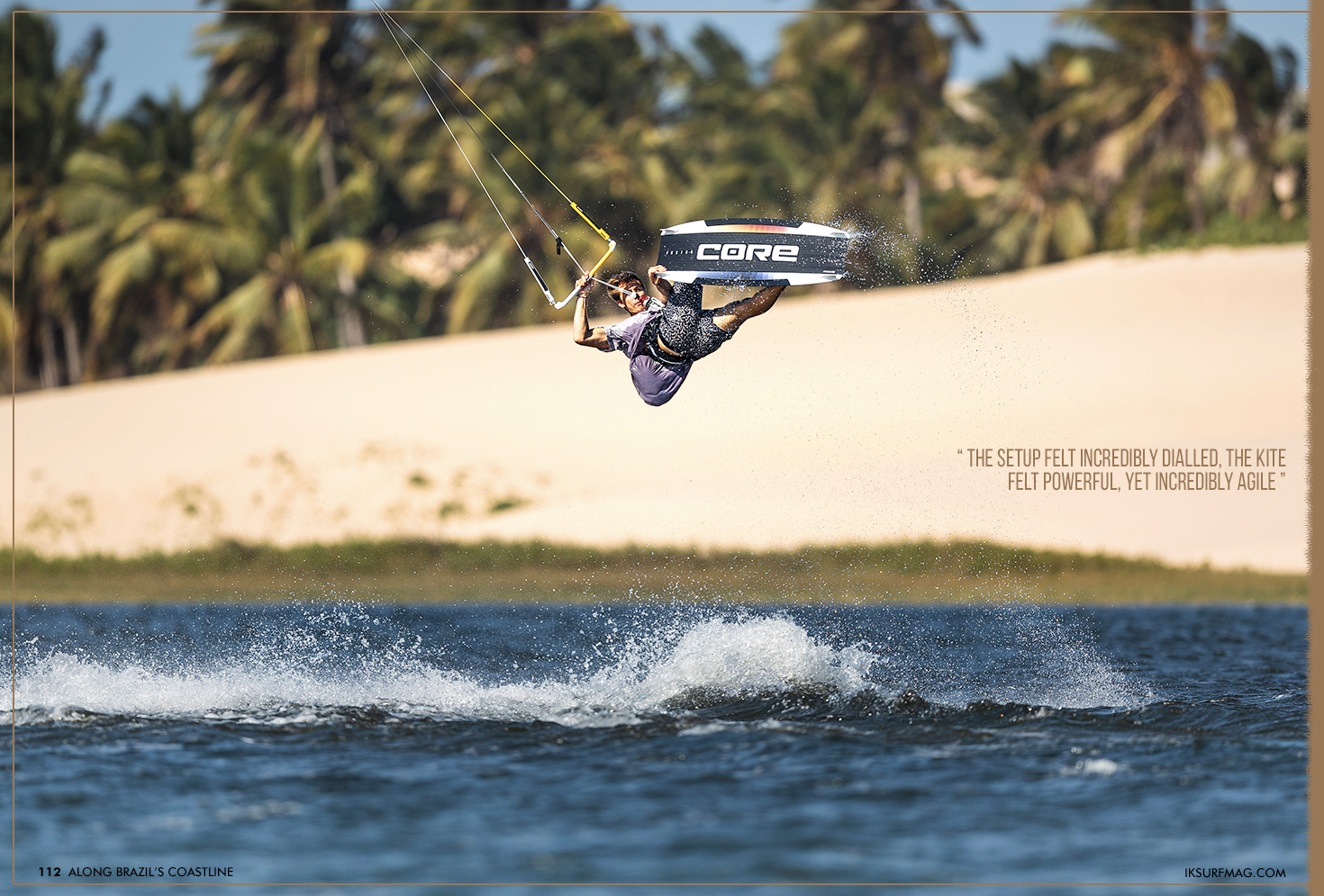
In those first sessions, the new Fusion 7 and Pace kite really impressed me. The setup felt incredibly dialled, the kite felt powerful, yet incredibly agile, while the board is just a real upwind weapon, without sacrificing an inch of performance. What surprised me most was how intuitive the gear felt from the moment I took it out of the bag. It just clicked. That gave us the freedom to fully focus on filming and exploring.
Right out of the gate, I realised that English wouldn’t get me very far with the locals and that my version of “Spanish,” a mix of French fragments from school and broken Italian-Latin hybrids, wasn’t much help either. Luckily, Juli, being South American, stepped in and taught me a few of the most essential phrases. At least enough to order açaí bowls, which turned out to be our most important source of energy for the weeks ahead. Learning even just a few phrases was helpful. People were even more welcoming, and although I couldn’t hold a proper conversation, there was always a way to connect, usually with gestures, a smile, or by sharing space on the beach. It made the experience feel more grounded and personal. Without knowing the language, you pay closer attention to everything else.
The first few days revolved around timing the tides to hit perfect conditions in river mouths and temporary lagoons that formed during high tide. Although Barra Nova isn’t a famous kitesurfing destination, we found steady wind, glassy water, and plenty of open space, a combination that made every session count.
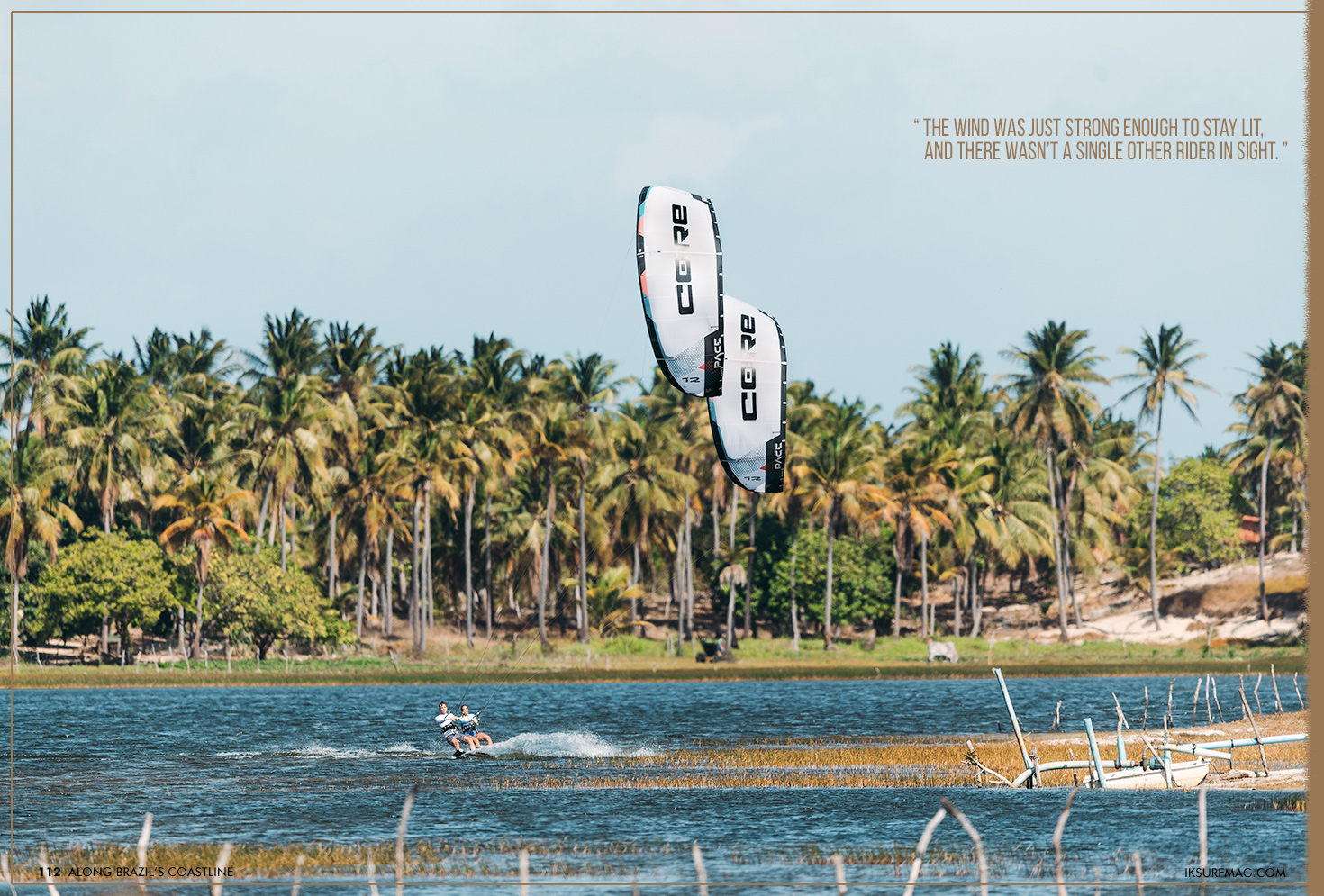
One session that really stood out was in a small river mouth just outside Barra Nova. The tide was pulling out, which created a natural upwind conveyor belt. The water was completely flat, the wind was just strong enough to stay lit, and there wasn’t a single other rider in sight. We rode until the sky turned pink and the cameras’ batteries ran out. It felt like a hidden gem, apart from the view, which was ours for the evening.
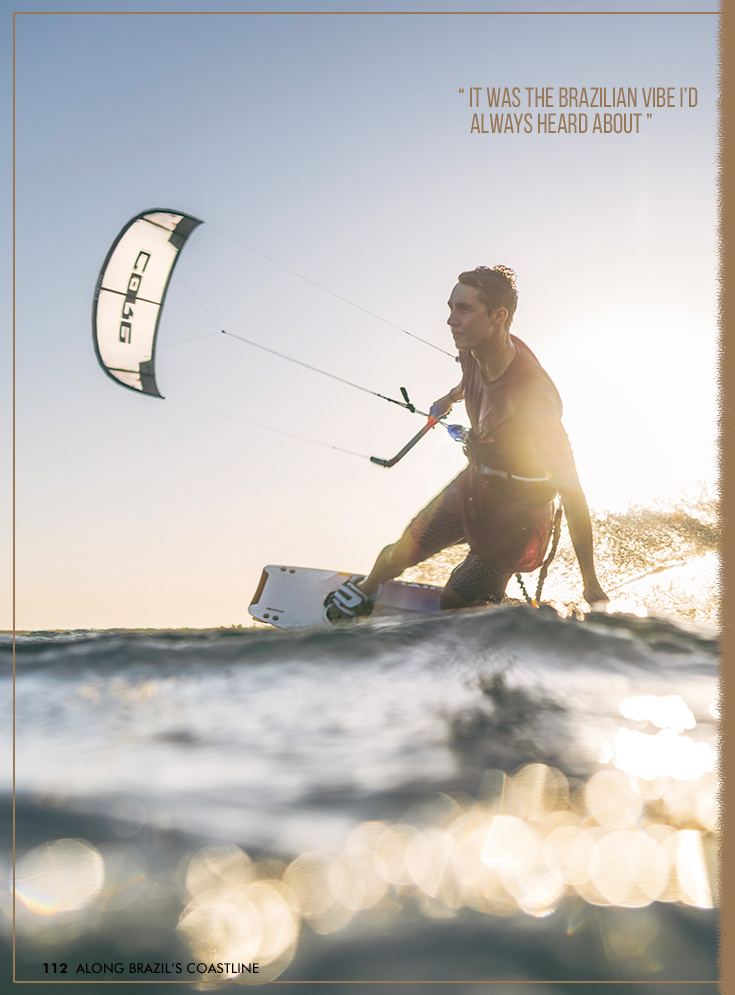
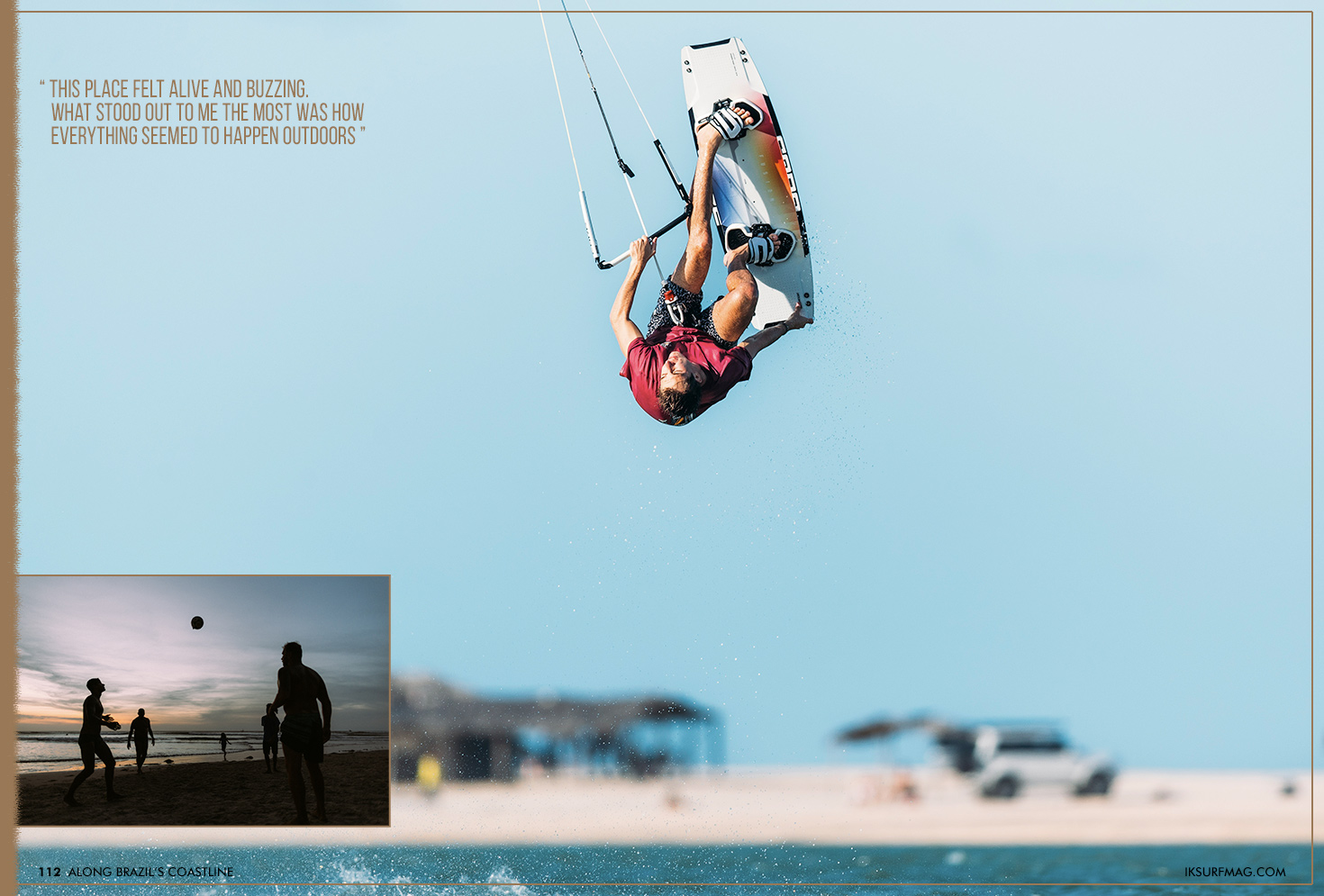
When the GKA World Tour arrived in Jericoacoara, we drove north to Preá, picking up Vrinda Hamal along the way. Our goal was to support the CORE riders competing at the event and document the action from the beach. It also gave me a chance to experience a very different side of Brazil. In Jericoacoara, life spills into every corner: people surfing, playing football on the beach, drinking cocktails in the sand. It was the Brazilian vibe I’d always heard about, something I hadn’t really found yet in the smaller fishing and farming villages we’d passed through.
Compared to the quiet rhythm of the smaller towns, this place felt alive and buzzing. What stood out to me the most was how everything seemed to happen outdoors. Something we in Europe are not necessarily used to.
Our teammates, Sahar and Zara, shook up the Big Air categories with strong performances. While it was cool to see what the GKA tour had to offer, standing on a windy beach without kiting wasn’t exactly what I came here for. So, I was happy when we packed the gear and got back on the road, continuing our search for new shooting locations.
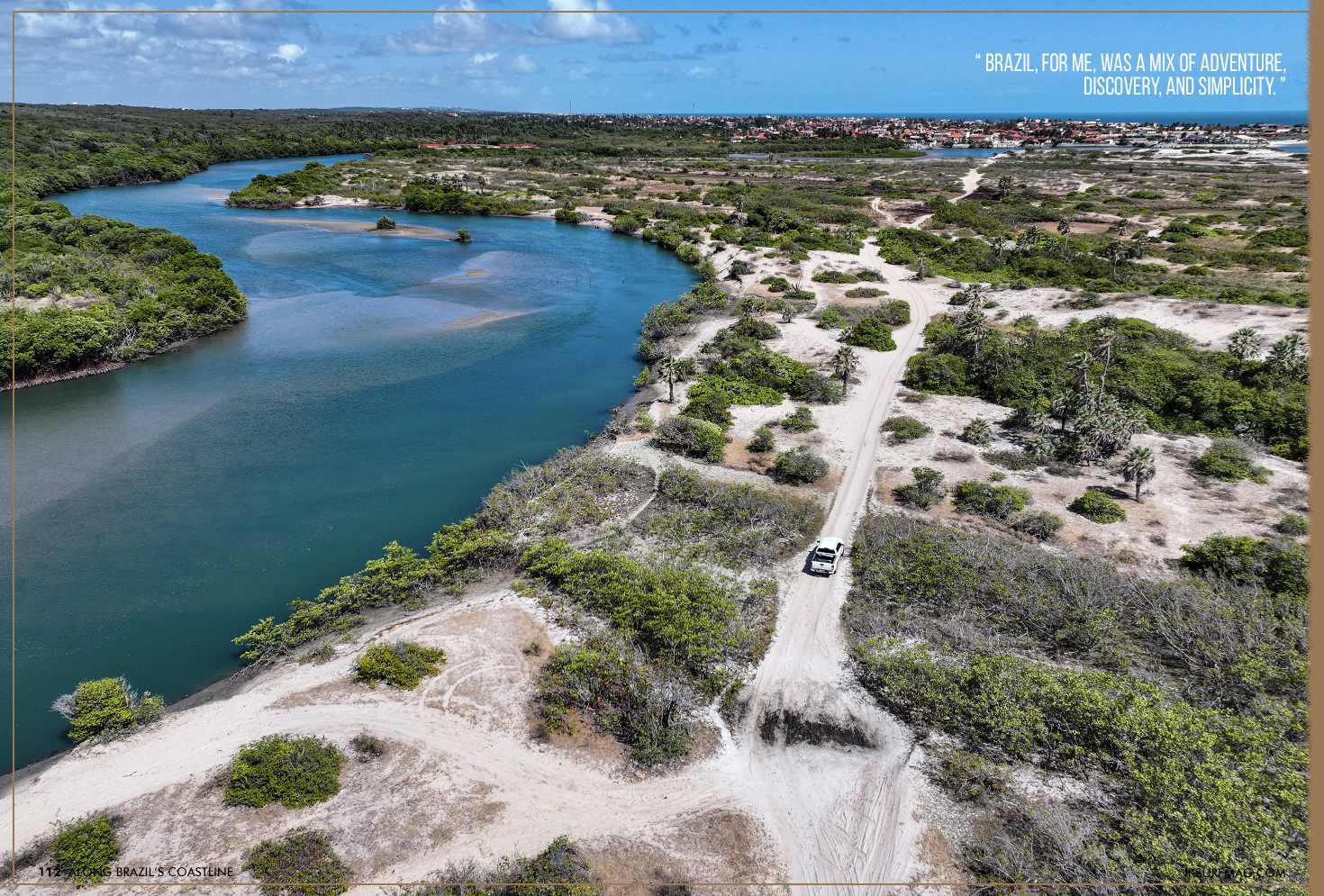
After the competition, we stayed in Preá and took day trips further along the coast. It was a different kind of exploration. We’d follow the shoreline, driving through mangroves, occasionally getting stuck in dunes, or finding ourselves at river mouths with no bridge. But even those weren’t dead ends. Local ferrymen offered passage on small handmade rafts powered by outboard motors. They didn’t always look seaworthy, but they worked.
One of the wildest moments was driving along a narrow section of beach as the tide rushed in. With thick mangroves on one side and the ocean waves on the other side, the drive was more nerve-wrecking than I would have liked, and getting stuck could have ended in disaster. When we finally found a small path that guided us off the beach and offered an alternative route through the mangrove jungle, we happily took it. Between digging out stuck cars under the midday sun and blazing heat, that was definitely a moment that stuck with me.
Although I enjoyed the scenery, being thrown around in a 4x4 all day was exhausting.
Still, it was worth it every time we left the busy beaches of Preá behind and got beyond the reach of the guided downwind groups. The landscape opened up: palm plantations, rural houses, and wide, untouched coastlines. Occasionally, we’d get puzzled looks from locals who clearly weren’t used to kitesurfers rolling through, but that just added to the experience.
Our final stop was Icaraizinho, where we were warmly hosted at Casa Zulu. Their beachside house was the perfect base for us. Kite gear stowed away, cameras charged, and each day, a new direction to explore. This region had the most varied and beautiful conditions of the whole trip. Along the coast, we found small, playful waves and stretches of tidal pools where the sandy beach met crystal blue water. What made Icaraizinho special was how effortlessly everything came together: the wind, the water and the landscapes. There was a session where we had playful waves on one side of a sandbar and flat water on the other. It felt like nature had shaped the perfect playground.
One lagoon in particular stood out. Cows grazed beside the water, palm trees all around, dunes separating the lake from the sea. It felt like a hidden oasis, and it also marked the end of my journey.
Brazil, for me, was a mix of adventure, discovery, and simplicity. We came for the gear, for the shoot, and for the sport, but what stayed with me was everything in between. The early mornings, the slow drives, the unplanned stops, the moments of connection. It’s a place I hope to return to, not just for the kiting but for the rhythm it offers.
If someone’s never been to Brazil, I’d say: be open. Don’t over-plan; the best parts come when you let the road decide. Learn a few Portuguese basics, bring more sunscreen than you think you need, and never skip the açaí.
Videos


By IKSURFMAG
